„Write an article about the importance of human writing.“
The capabilities of text-generating AI tools—ChatGPT above all—have reached impressive proportions. Impressive and frightening. A short headline is generated in the blink of an eye, as is an entire book. Or this article. The question is: at what cost? As a trained old-school copywriter, I have to speak up for real writing. The flesh-and-blood kind. Where brainpower turns into words and what’s written still aims to be read.
Yes, this topic strikes a nerve for us advertisers. After all, it’s about our very right to exist. But luckily, this is not just emotional self-defence. There is rational substance behind it. My words are still needed. To make that clear, I’m even writing this article myself (spoiler: I did have a little AI help too).
What makes a good text good?
A good text tells a story. Stories are created where something is experienced. That’s exactly the crux of it. AI doesn’t experience, it repeats what has been experienced. AI doesn’t feel, it describes existing feelings. AI reproduces. What grips us are first-hand stories, emotional depth, and contextual understanding that only someone who was there can offer. We look for originality, for surprise. For the unexpected and the limits of human imagination.
Sometimes a good text is just one word. The difference lies in where it comes from and where it wants to go. A human can determine that and understand and satisfy the emotions, wishes, and needs of those they reach. They can recognize cultural nuances and build closer ties to the target group, evoke feelings. They draw from personal anecdotes and use subtle humor. All of this can have significant effects, as practice shows. Human ad copy tends to achieve more impressions, more clicks, and a higher click-through rate in A/B tests. It’s better, there’s no doubt about that, but it’s also usually more successful.
Five weaknesses of AI and how to spot them
AI draws on more knowledge than any human on Earth. But quantity doesn’t always beat quality. Although artificial intelligence continues to evolve, as of January 2026 it still lacks one crucial ingredient for perfection: humanity.
AI hits the tone, not the point.
AI-generated texts are correct, they usually solve the task at hand. But they aren’t pointed—they don’t carry a stance. While good texts leave space, AI fills it with unnecessary explanations.
Callout: Everything is correct, just a bit too correct? AI alarm!
AI isn't funny.
You can compare AI’s entertainment level to a “The 1000 Funniest Jokes” book. Guaranteed unfunny. Humor comes from friction, from context. A joke isn’t equally funny in every situation. AI wordplay is usually explanatory, far too well-behaved, and predictable. Because it has been predicted.
Callout: No extremes, no edge? Probably AI.
AI is unoriginal.
The goal of every good piece of advertising is to create something you haven’t seen in that form before. To do that, you have to think against patterns. AI can’t do that by definition—it thinks in patterns and probabilities. Where existing things are combined, surprise is never born.
Callout: If something sounds and feels very familiar, it often does because it is. AI!
AI has no gut feeling.
Fundamentally, AI is only as good as the information you feed it. The more you teach it, the closer it gets to the desired result. But some things can’t be put into words. AI doesn’t read between the lines. AI doesn’t know people, it knows personas. And that’s exactly why AI texts often sound interchangeable: because they don’t speak to individuals.
Callout: Superficial, impersonal? AI!
AI doesn't know context.
AI is omniscient, and in doing so it loses its eye for detail. Local codes, social tensions, and trends push it to its limits. It comes across like an outside observer. Either it over-explains or it ignores. There’s no subtle resonance.
Callout: If a text sounds like Armin Wolf during the annual presentation of the youth words of the year, then AI is often the reason.
The power of strong copy
“Just do it.” Three words. Simple, unspectacular. And yet we all connect them with a brand, a feeling. The effect is hard to explain with logic; the reduction to the essential makes sense to us because we understand the context, recognize the story, identify, and feel connected. Things we have over AI. A sentence that understands human motivation and remains open to interpretation.
Haus der Barmherzigkeit and Saint Charles teamed up for a clean cause. A hand soap that donates to the residents of Haus der Barmherzigkeit with every purchase. A beautiful story if you tell it right. We use short headlines to get to the point. We capture the lightness of Haus der Barmherzigkeit and the stance of Saint Charles, add wordplay without losing sight of the seriousness, explain without spilling it out. Headlines that feel spontaneous but are well thought out and built on a foundation of brand understanding, experience, and tact.
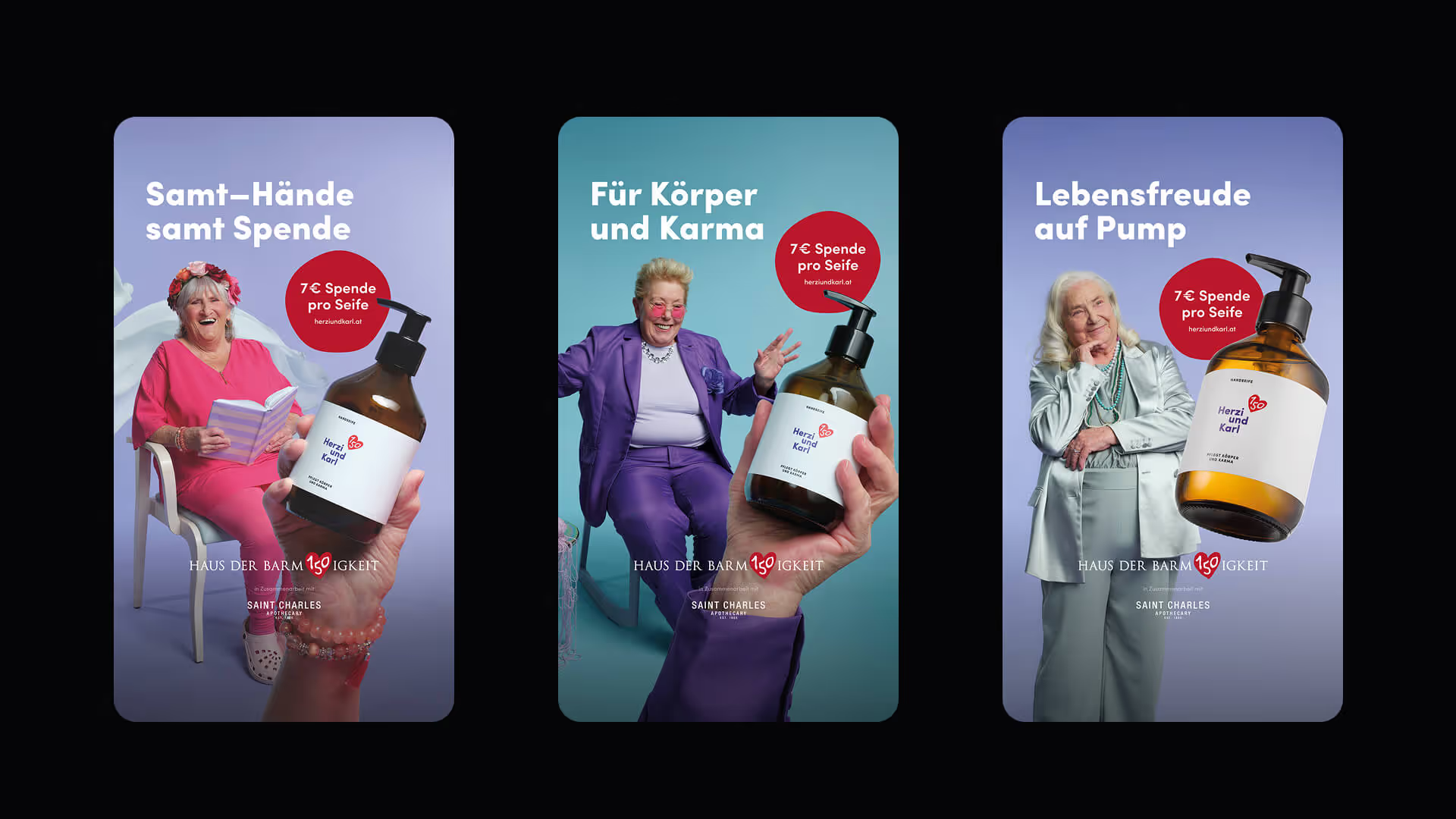
Quote explanation:
"Samt-Hände samt Spende" means "Velvet hands including a donation"
The charm comes from the repeated “samt”, which means both “velvet” and “included/along with,” creating a double meaning and a soft, catchy sound pattern.
"Pflege für Körper und Karma" means "care for body and karma"
It pairs physical care with moral “care” (doing good) and the Körper/Karma alliteration plus matching rhythm make it easy to remember.
"Lebensfreude auf Pump" means "joy of life on tap"
“Auf Pump” stacks three meanings at once: it’s an idiom for “on credit / buy now, pay later,” it points literally to the soap dispenser pump, and it echoes the heart pumping as a symbol of vitality. Together, it turns “Lebensfreude” into something you can dispense, feel, and even “advance” through giving.
Cringe pick-up lines in ads feel pretty cheesy—unless the thing you’re trying to pick up is a pickup. For the MAXUS eTERRON 9, we looked for the linguistic overlaps between the car and dating worlds—conceptually so unusual that it’s completely new territory even for AI, and therefore hard to grasp. A campaign with ambiguous wording and associations that only (pretty creative) humans can come up with.

Quote explanation:
"Hast du zwei Motoren oder warum bringst du mich so schnell in Fahrt" translates to "Do you have two motors, or why do you get me going so fast?"
"Bist du elektrisch? Denn du erhellst definitiv meinen Tag" translates to "Are you electric? Because you definitely light up my day."
"Bist du magnetisch oder warum schleppst du alles ab?" translates to "Are you magnetic, or why do you tow everything away?"
"Abschleppen” is double-coded in German: in a dating context it can mean to “pick someone up” / pull someone (colloquially, to take someone home), and in the car world it means to tow.
"Dinge, die man nur zu Österreichs ertem volleketrischen Allrad-Pick-up sagen sollte." translates to "Things you should only say when talking about Austria's first fully electric 4x4 pickup truck."
Another well-rounded piece of writing is our audio guide for ivie by WienTourismus — taking visitors on a full circle around Vienna’s Ringstraße. Wordplay with local flavor—that’s something humans can still do a lot better than AI. The difference shows in the fine nuances that make up Vienna’s charm. The story about Café Prückel, for example, comes from a Viennese voice, you can tell. You get the Viennese coffeehouse feeling if you’ve been in a Viennese coffeehouse; otherwise you don’t. Historical associations are also embedded cleverly and subtly, like the newspapers that are inseparable from the café, or the ambivalence between hustle and relaxation.
Our lines, but make it AI
What if AI entirely took our jobs? Let’s try it! I asked ChatGPT (we use the current 5 Pro version) to give me headlines for our Herzi & Karl soap based on the briefing, with the goal of delivering premium, double-meaning wordplays that match the attitude of both cooperation partners.
The results are correct and clearly explain what it’s about. At the same time, they feel uninspired, too fully spelled out, and uncomfortably ad-like: “Make it clean. Make it good.”, “More than just clean hands”—you can sense the recycled phrases, you can smell the advertising from afar. “Clean hands. Good heart”, “Wash hands. Give joy.”—everyone understands what it’s about. None of these lines would stick though, they’re too obvious. “A little care. A big impact.”—at least the double meaning of care for hands and for residents resonates here. We get a little closer to our human lines, but this headline isn’t truly convincing either. AI lacks any wordplay; there’s no subtle feeling in it, you don’t feel the love that makes this action so unique. Basically, the headlines are interchangeable. And they show: we are (still) not interchangeable.
One needs the other
But AI is far from the enemy. It’s not about WHETHER you use artificial intelligence, but HOW. AI is fast, and therefore cost-effective and efficient. Humans are more creative and emotional. A middle path combines the best of two worlds and is the way to go. Take this article as an example. Starting from the human core idea—an article meant to justify my job—AI helps with structuring, research, and early drafts of the outline. The phrasing and the surprising elements—the nuances—are handled by the author. At the end, an AI counter-check ensures grammatical perfection. Hence, a helper tool. A ping-pong partner. In practice, AI is also an excellent tool for scaling: for example, implementing texts for Meta, emails, etc., starting from a human idea or copy. That’s how engagement and economic efficiency can be combined.
It all comes down to decision
AI is changing the work in advertising. But it doesn’t take responsibility off our hands. We decide. When to reduce. When to be silent. When one word is enough. When it takes a sentence. AI is a tool for copywriters—those who understand it and use it correctly can draw creative profit from it. Those who let it replace people become interchangeable. Those who ignore it are lost anyway. The future of advertising needs AI. And it needs people. It is conscious.